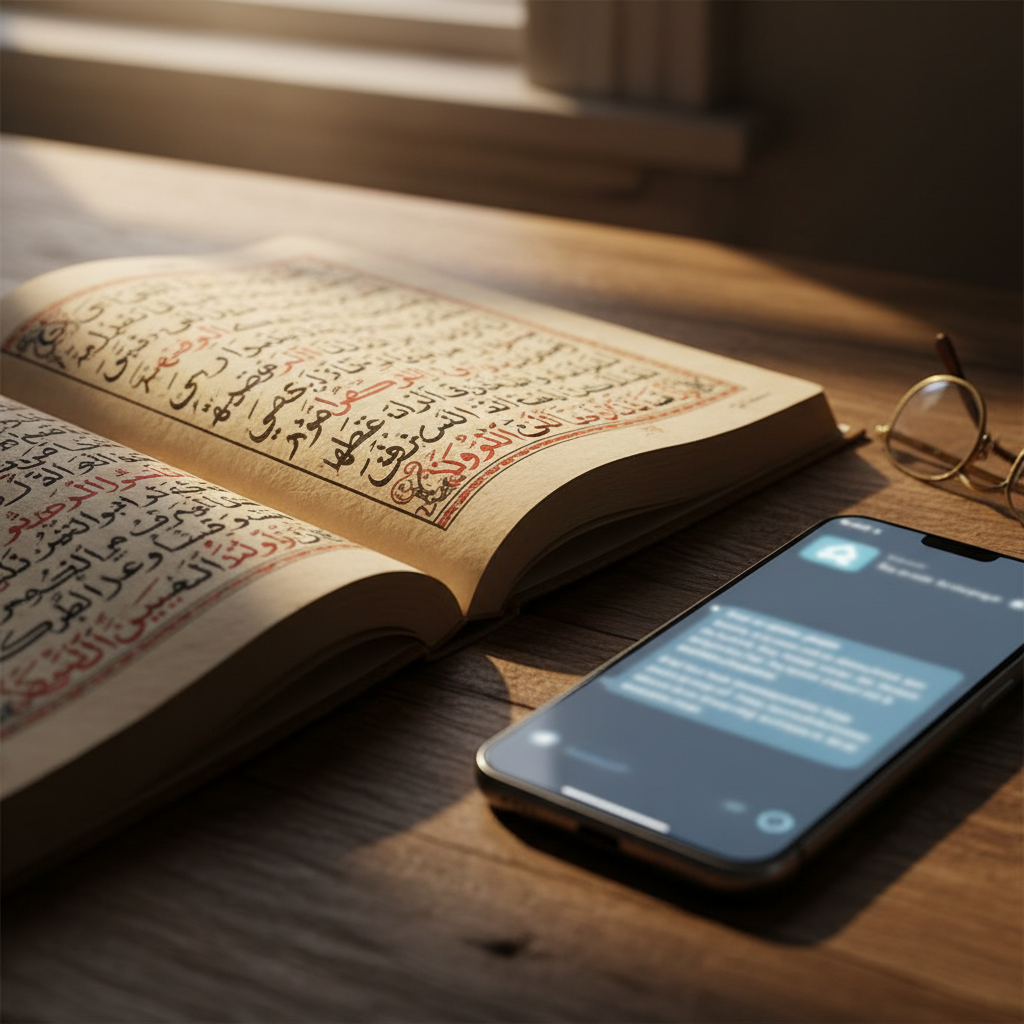
It's past midnight. A young Muslim — a recent revert — sits alone, staring at the glow of a phone screen. A question has been weighing on his heart all day. With no teacher nearby and no one to ask, he turns to what millions now rely on: Artificial Intelligence.
Within seconds, the answer appears. It's articulate. Confident. It quotes a verse from the Qur'an. It cites a hadith. It even mentions a scholar. Everything about it feels right.
Except… it isn't. The verse doesn't exist. The hadith was never narrated. The scholar is real, but the quote is fabricated. And the answer sounds completely convincing.
The Silent Shift: From Scholars to Software
Not long ago, Muslims turned to parents, teachers, imams, and trusted books for guidance. Today, that process has been quietly replaced. Questions about Islam are now being asked to AI tools — instantly, privately, and without judgment.
- Available 24/7 — No appointment needed
- Feels approachable — No judgment
- Responds instantly — No waiting
- Speaks your language — No translation
For many — especially younger Muslims and reverts — AI has become the first point of contact with Islamic knowledge. But here's the uncomfortable truth: convenience has increased. Reliability has not.
The Core Problem: AI Does Not Know — It Predicts
AI doesn't "understand" Islam the way a scholar does. It does not verify sources. It does not assess chains of narration. It does not distinguish truth from fabrication. Instead, it predicts words based on patterns it has seen across the internet.
What the internet contains:
- Authentic hadith collections — and fabricated narrations
- Scholarly works — and anonymous blog posts
- Careful jurisprudence — and personal opinions
To AI, all of it looks the same.
This is what researchers call "hallucination" — when AI produces information that sounds correct but is entirely fabricated. In everyday topics, that's an inconvenience. In Islam, it is dangerous.
A Deeper Threat: The Weaponization of Misinformation
The issue is not just accidental error — it's manipulation. Because AI learns from publicly available content, anyone can influence what it learns. A malicious individual can invent a fake hadith, attach a false reference, publish it online. The AI absorbs it. Later, when someone asks a question, the AI may confidently repeat that lie — complete with a fabricated citation.
For centuries, Islamic scholarship protected truth through isnad — the chain of transmission — ensuring every narration could be traced and verified. AI systems ignore this entirely. They have no chain. No accountability. No verification.
What the Research Says (2025)
Until recently, concerns about AI and Islamic misinformation were mostly anecdotal. That changed in 2025. A major academic study — IslamicEval 2025 — was conducted by researchers from Qatar University, the University of Edinburgh, and others. Their goal: measure how accurately AI models cite hadith.
The findings were alarming. Even the best-performing systems got over one-third of hadith citations wrong.
"Hallucination prevention must happen during generation — not after. You cannot reliably fix false information after it's generated. You must prevent it from being created in the first place." — ISLAMICEVAL 2025 RESEARCHERS
Why This Matters in Islam More Than Anywhere Else
Islam is not built on assumptions. It is built on preservation. The Qur'an itself commands:
"O you who believe, if a transgressor brings you news, verify it…" — QUR'AN 49:6
"Whoever lies about me intentionally, let him take his seat in the Fire." — BUKHARI
Attributing false statements to the Prophet ﷺ is among the gravest of sins. Yet today, AI can generate thousands of fabricated narrations — instantly, fluently, and convincingly. And those least equipped to verify them — sincere seekers — are the most vulnerable.
The Real Issue Isn't AI — It's Blind Trust
The danger is not artificial intelligence itself. The danger is treating unverified AI-generated answers as authentic Islamic knowledge. A tool without sources cannot carry the weight of revelation. No matter how confident it sounds.
A Better Direction: Source-Driven AI
If AI is here to stay — and it is — then the solution is not rejection. It is reform. A new approach is emerging: source-driven AI. The future of Islamic AI must be grounded in authenticated texts.
- Uses only verified Islamic texts
- Provides clear citations for every claim
- Includes authentication grades for hadith
- Refuses to answer when sources are silent
It prioritizes accuracy over fluency. Because in Islam, silence is better than speculation.
Moving Forward as an Ummah
Verification has always been at the heart of Islamic scholarship. We are standing at a turning point. A generation is growing up learning Islam through screens. If we are not careful, they may inherit confidence without verification, knowledge without chains, answers without accountability.
- 📚 Students verifying sources instantly
- 🏫 Teachers guiding with authenticated tools
- 🤲 Reverts learning with clarity and trust
Technology should not replace scholars. It should support them.
A Simple Question That Changes Everything
The next time you receive an answer about Islam — especially from AI — pause and ask: "Where is this from?" And more importantly: "Can it be verified?"
That question has protected this Deen for over 1,400 years. It still does. Because in Islam, truth is not what sounds right. It is what is proven. ■
Reference: Mubarak, H., et al. (2025). "IslamicEval 2025: The First Shared Task of Capturing LLMs Hallucination in Islamic Content." Proceedings of the Third Arabic NLP Conference, pp. 480–493. DOI: 10.18653/v1/2025.arabicnlp-sharedtasks.67
Join the founding circle
Get early access when the engine launches. No spam, just progress.